

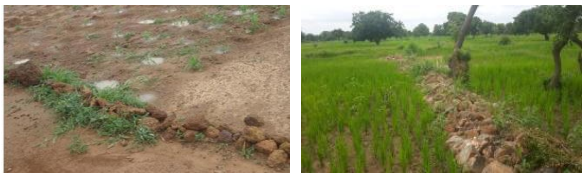
 In West Africa, climate change is manifested through various facts. According to the 5th Evaluation Report by the Intergovernmental Panel on Climate Change (IPCC), temperatures observed in West Africa have increased over the past 50 years. It was noted that the number of cold days and nights has dropped and that the number of hot days and nights have increased between 1970 and 20106. With regard to rainfall, they have declined during the last 50 years with the migration of isohyets towards the south.
This increase in temperature, noted in all the countries concerned by the project has had an impact on the means of agricultural production of the populations and has reduced the capacity of the natural regeneration of the ecosystems. With the future looking even worse for Africa and particularly West Africa, these impacts will continue to grow.
The Regional Project aims to reduce the vulnerability of farmers and pastoralists to increase climatic risk, which undermines the level of food security, income generation, and the supporting ecosystem services of poor communities.
The specific objectives of the project are:
- Strengthen knowledge and technical capacity through regional and local interactions for the promotion of agriculture practices resilient to the adverse effects of climate change;
- Scaling up best practices related to climate change adaptation in agriculture and pastoralism at local and regional level
- Share knowledge and disseminate lessons learned on resilient agricultural best practices related to climate-smart agriculture
The project consists of three components:
- Component 1: Strengthening knowledge and technical capacity through regional and local interactions for the promotion of agriculture practices resilient to the adverse effects of climate change
- Component 2: Scaling up best practices related to climate change adaptation in agriculture and pastoralism at the local and regional level
- Component 3: Knowledge Sharing on Resilient Agricultural Best Practices Related to Climate-Smart Agriculture
| Project Component 1: Strengthening knowledge and technical capacity through regional and local interactions for the promotion of agriculture practices resilient to the adverse effects of climate change | US$ 2,285,000 |
| Project Component 2: Scaling up best practices related to climate change adaptation in agriculture and pastoralism at the local and regional level | US$ 8,848,000 |
| Project Component 3: Knowledge Sharing on Resilient Agricultural Best Practices Related to Climate-Smart Agriculture | US$ 440,000 |
| Project Execution Cost | US$ 1,331,000 |
| Total Project Cost | US$ 12,904,000 |
| Project/Programme Cycle Management Fee charged by the Implementing Entity | US$ 1,096,000 |
| Grant Amount | USD 14,000,000 |
Project Documents
| Attachment | Type | Size |
|---|---|---|
| Project document | - | |
| Project pre-concept | - | |
| Project concept | - | |
| Inception Report | - | |
| Inception Report | - | |
| PPR1 (for web) | XLSX | - |
| PPR2 (for web) | XLSX | - |
| PPR3 (for web) | - | |
| PPR4 (for web) | - |