



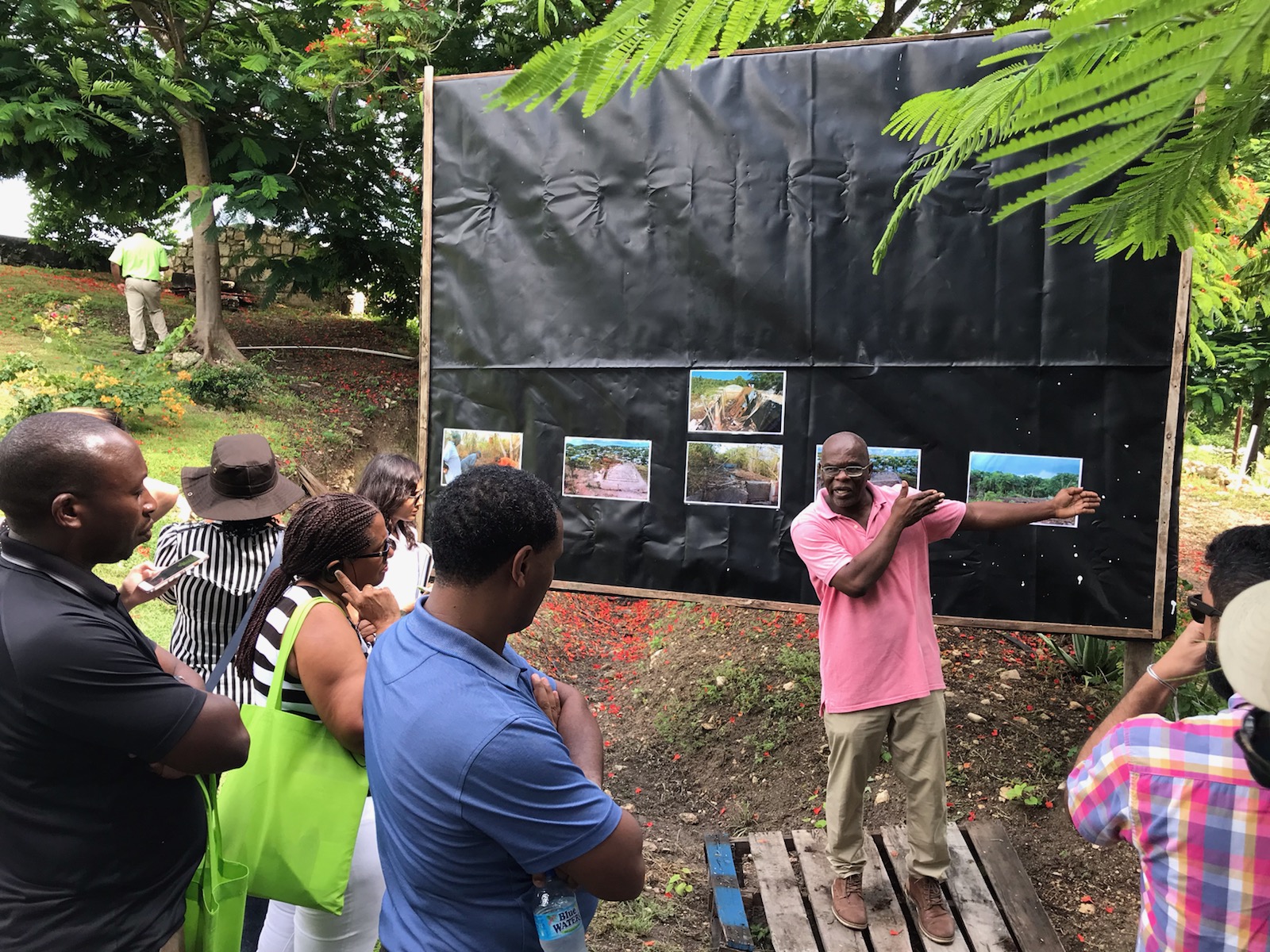
A project representative presents adaptation activities and results to visiting stakeholders during an Adaptation Fund workshop and project visit in Antigua and Barbuda. Photo Credit: Adaptation Fund
Even before Hurricane Irma ravaged neighboring Barbuda in September 2017, people in Antigua knew they needed to protect themselves from floods. Both Caribbean islands face increasingly frequent and severe storms, and sea-level rise and development have made it harder for rainfall to drain off safely.
So the Department of Environment, Antigua and Barbuda’s national implementing partner for the Adaptation Fund (AF), secured US$10 million from the Fund’s direct access modality to tackle flood risks and other climate hazards in Antigua’s northwest coastal McKinnon’s watershed. Much of the funding went to upgrading drainage systems and strengthening local adaptation capacities in communities. Another US$3.1 million was allocated to low-interest loans so people could climate-proof their own homes.
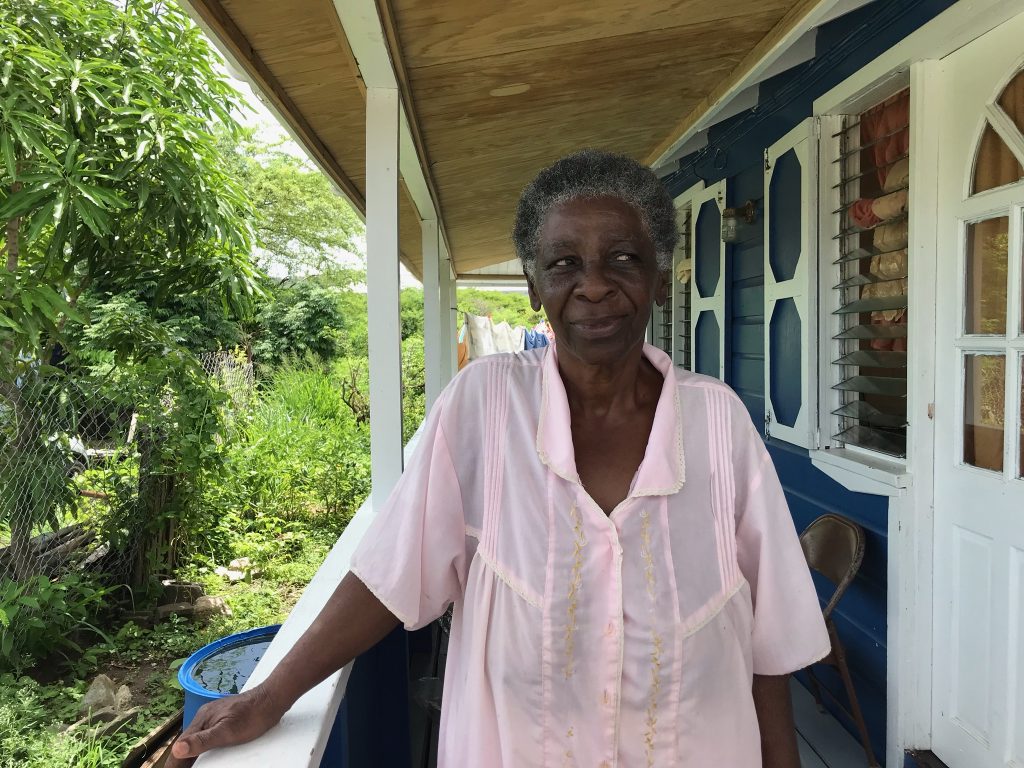
For Muhamad Arfin, of Gambles Terrace, the priority was to improve gutters and drainage – “something proper to get rid of the water.” For Elaine Nedd Perry, of Yorks Village, the goal was to raise her house, which would flood with 20-30 cm of water during storms. The loan was a great help, she said, because given the severity of the flood risk, “it is very difficult to get a regular loan”.
These kinds of investments can have wider benefits, with evidence from beneficiaries indicating that the storm-proofing measures implemented under the project enabled households and small businesses to become insurable, something that had previously been out of reach.
The missing link: finance people can use
The same access-to-finance challenge is shaping new Global Environment Facility (GEF) support in Bangladesh, where the Least Developed Countries Fund is backing mangrove restoration alongside financial inclusion and market access for climate-resilient livelihoods. Healthy mangroves can buffer shorelines and help protect embankments from storms and erosion, while access to financial literacy, formal finance, and local markets can help communities build viable livelihoods from healthier coastal ecosystems. Together, these investments aim to strengthen household resilience while giving communities a lasting stake in protecting the mangroves themselves.
Across these different contexts, the underlying barrier is similar. Many households and small enterprises want to adapt to climate change, but they don’t have enough money and can’t access finance – because they’re deemed too risky, are seeking only small amounts, or have no relationship with a financial institution. The loans that are available to them, often from local lenders outside the banking system, may impose highly exploitative terms, pushing them into debt traps.
The AF and GEF are addressing this problem by strategically investing in financial inclusion – supporting projects that work with local banks, credit unions, cooperatives, and other partners to make finance more accessible to vulnerable communities, on just terms. Financial literacy training is often a key component as well, helping people understand the options available and use finance to act on their own adaptation priorities.
For both funds, this reflects a broader push to make adaptation finance more locally relevant and easier to access. The AF has long emphasized direct access and is expanding support for locally led adaptation and innovation. The GEF, meanwhile, is placing stronger emphasis on whole-of-society approaches in its adaptation programming, including partnerships with local governments, civil society, community organizations, financial institutions, women, youth, Indigenous Peoples, and local communities. Financial inclusion is one practical way to turn that ambition into action: helping people not only identify the resilience measures they need, but access the tools to carry them out.
“We’re tackling one of the greatest barriers to adaptation,” said Justice Musah, a climate change specialist at the AF. “Access to even a modest amount of finance can be life-changing for many people. This is a highly effective way to support tailored adaptation solutions, with the potential to reach massive scale.”
Reaching the ‘last mile’
The AF and GEF began investing in financial inclusion as a way to address a key concern in adaptation finance: how to deliver tangible benefits at the local level. Many projects benefit thousands or even millions of people indirectly through infrastructure investments or government programs, but even if local communities are consulted or actively engaged, historically, they have had direct control over only a small fraction of disbursed funds.
Locally led adaptation, which both funds are increasingly supporting, deliberately puts funds and decision-making power in the hands of local communities, enabling them to pursue their own priorities. Financial inclusion initiatives build on this approach to reach individual households and enterprises.
“This is among the most effective and powerful ways to support locally led adaptation at scale,” said Jason Spensley, a senior climate change specialist at the GEF. “It is also a very effective way to sustain the impact of projects after they close, because people at the front lines of the climate crisis will be empowered with much-needed resources, and financial institutions will have gained crucial experience supporting adaptation.”
Different approaches for different communities
In practice, financial inclusion initiatives to support adaptation can take multiple forms, and this diversity is reflected in the projects funded by the AF and GEF to date. The Antigua project, for instance, expanded access to credit by building the capacities of financial institutions to integrate climate risk into their lending practices, helped them develop microloans to support resilience, and developed a self-sustaining, low-interest revolving loan fund for community members to access.
A US$5 million AF-financed project in Bhutan, meanwhile, implemented by the World Food Programme through AF’s innovation facility , has focused on designing and refining microinsurance products for smallholder farmers, testing prototypes seasonally. Microfinance institutions are playing a key role, connecting farmers not only to insurance, but also to savings products and green loans.
As part of its Challenge Program for Adaptation Innovation, in 2024 the GEF awarded a US$1 million grant to Farm Africa for an initiative combining inclusive microfinance for small-scale farmers and micro-businesses with market mechanisms that will enable farmers to monetize climate resilience outcomes. Along with pioneering a novel approach, the project is building an important partnership: the UBS Optimus Foundation is co-creating the market mechanisms.
While most of the projects launched to date involve banks, insurance companies, and/or microfinance institutions, both Musah and Spensley stressed that many financial inclusion initiatives can involve a wide variety of partners. Farmers’ cooperatives and women’s self-help groups, for instance, already provide loans to their members, and they could provide greater resources if supported by climate finance.
The goal, they said, is to deliver finance to vulnerable communities, and that means working with entities that are already known and trusted in those communities. This is also why microfinance providers are crucial partners. What these partners have in common is an ability to reach people where they are – which state-run programs often cannot – and connect them with financial tools that can meet their needs.
At a different scale, the same principle is being applied through public finance systems. In Solomon Islands, support from the GEF’s Least Developed Countries Fund is being combined with World Bank International Development Association finance to help rural wards identify and deliver climate-resilient infrastructure and services through performance-based grants, ward development planning, and stronger provincial accountability. The project has already reached more than 107,000 people, showing how adaptation finance can move through national and local systems while still responding to community priorities.
Scaling what works
Both funds have supported multiple financial inclusion initiatives, with some projects (such as the one in Antigua) already completed. While the use of microlending strategies to enable adaptation is still relatively new, particularly for multilateral climate funds, both the AF and the GEF are committed to scaling up these practices in their respective portfolios.
“This is a major focus in the GEF-9 climate adaptation strategy for 2026-2030,” said Spensley. “We are looking for quality finance as much as quantity and want the adaptation benefits from these projects to be carefully measured, tracked, and reported. The more we demonstrate the impact, the faster we can scale these approaches around the world.”
Financial inclusion is also a priority for the AF, as part of a growing focus on locally led adaptation in its Medium-Term Strategy 2023-2027. Its pioneering direct access modality has had a longstanding focus on making climate finance available directly to countries, and now the AF offers explicit locally led adaptation funding windows, as well as innovation in adaptation grants that are open to a wide range of local entrepreneurs, NGOs, Indigenous Peoples, women, youth and community groups, among others.
“We are proud to be helping to build new systems and shape new markets for inclusive finance for resilience,” Musah said. “At a time when global ambition for climate finance is declining, this approach helps deliver broader, more inclusive development benefits across communities.”
This story is a joint production of the Adaptation Fund (AF) and the Global Environment Facility (GEF).
The AF and the GEF are part of the broader multilateral climate finance system helping developing countries turn adaptation priorities into practical action. While each fund has its own mandate, governance, and funding channels, they are increasingly advancing complementary approaches to locally led adaptation – from direct access and community-level projects to innovation, financial inclusion, and partnerships with trusted local institutions. By learning across their portfolios and supporting models that can be tested, adapted, and scaled, the two funds are helping expand the reach of adaptation finance to the households, businesses, farmers, and communities that need it most. Alongside their collaboration with other multilateral climate funds, this work reflects a growing effort to make adaptation finance more accessible, locally relevant, and responsive to country priorities.