



![[UN-Habitat Cambodia] Enhancing the Climate Resilience of Vulnerable Households Through Resilient Housing Units](https://www.adaptation-fund.org/wp-content/uploads/2025/11/Field-visit-to-showcase-climate-resilient-construction-techniques-applied-scaled.jpg)
Kep, 5, November 2025 – Along southwestern Cambodia’s coastal areas fronting the Gulf of Thailand, , small vulnerable settlements face many challenges stemming from climate change.
In Kep Province and Prey Nob District in Preah Sihanouk Province, many households live in poor housing conditions in terms of structure, materials, and thermal comfort — making residents vulnerable to climate hazards.
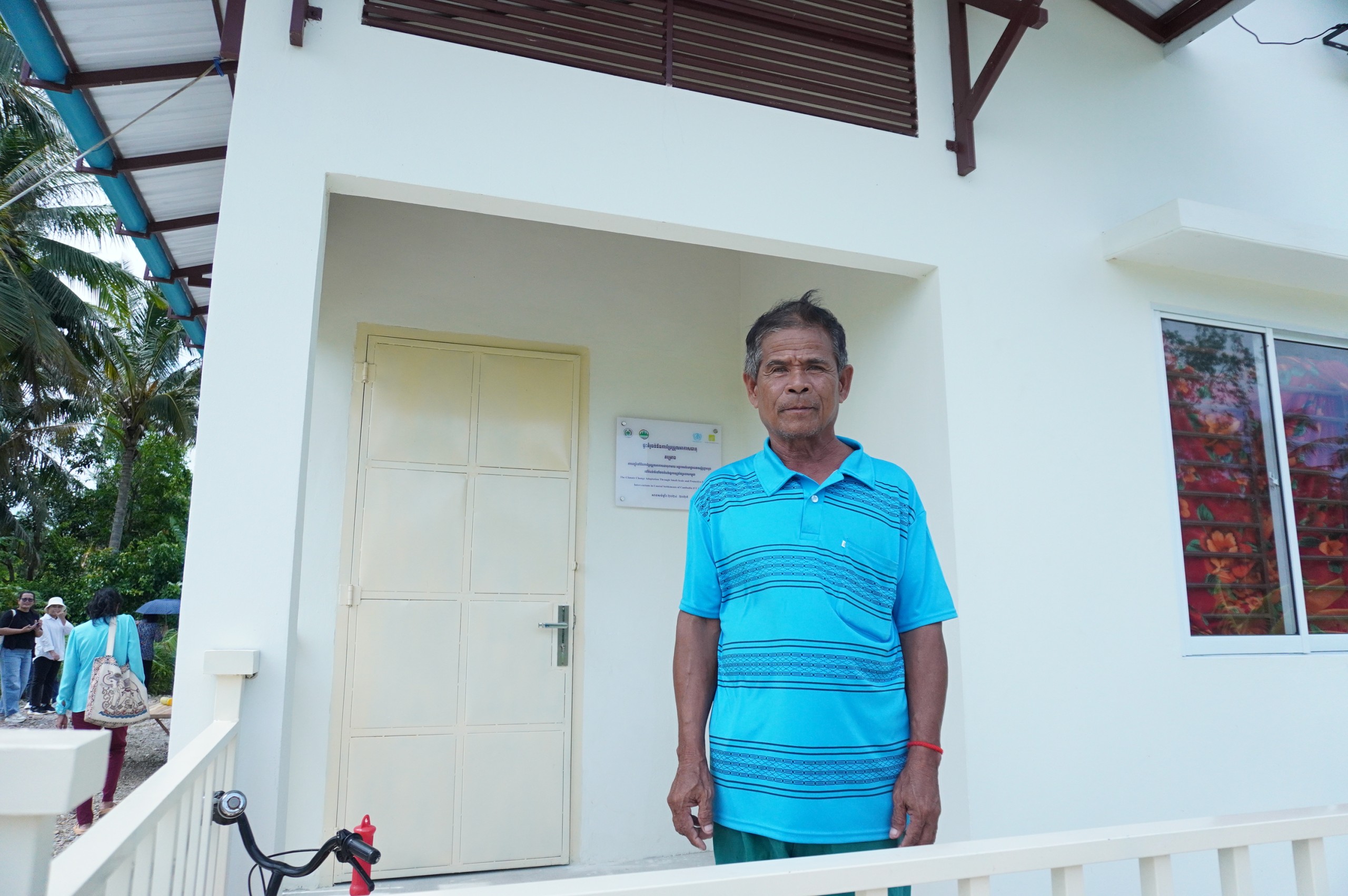
Mr. Ao Soun, a 70-year-old with a disability, is one of many beneficiaries of a project funded by the Adaptation Fund and carried out by UN-Habitat to help these communities adapt and build climate resilience. , Every year, he and his wife struggle to keep their modest home standing from the same climate issues — strong winds, heavy rain, flooding, and extreme heat. “We suffer from these climate issues every year,” he said. “We have to spend to repair the house, and it has become a heavy burden for our family.”
To enhance climate change adaptation and resilience of the most vulnerable coastal human settlements, UN-Habitat has been implementing the project with the National Council for Sustainable Development (NCSD) and the government’s Ministry of Environment. For example, the project constructed 20 resilient demonstration houses in Kep Province and other seven houses in Prey Nob district.. These demo housing units are affordable, climate-resilient, and replicable. They include features such as elevated reinforced foundations for flood protection and strong wind resilience, strong beams, anti-heat roofing to reduce indoor temperatures, and solar panels connected to an off-grid energy supply. The units also adopt other features, from rainwater harvesting tanks, ventilation systems, and disability-friendly handrails to ensure houses are inclusive, environmentally responsive, and future-proofed for extreme weather conditions.
“The new house is very comfortable both day and night, without fear of heatstroke, and roof damage from strong winds, rain, or flooding,” said Mr. Ao Soun. “We can save on repair costs and invest in other needs.”
To showcase and promote replication of these climate-resilient and affordable houses in various vulnerable communities in Cambodia, UN-Habitat also organized a recent knowledge sharing activity that gathered key actors in the affordable housing sector. Participants attended from the General Department of Housing, the Ministry of Land Management, Urban Planning and Construction (MLMUPC), the NGOs Housing Network, Habitat for Humanity, World Vision, NGOs Forum and others.
Key outcomes included knowledge sharing among stakeholders based on a walkthrough of the newly built affordable, climate-resilient housing models completed through the project, as well as dissemination of the project’s good practices, lessons learned, and recommendations to replicate them in other vulnerable settlements of Cambodia.
Speaking on behalf of the NGOs Housing Network, Ms. Soum Samoun, Executive Director of the Urban Poor Women Development (UPWD), praised the resilient housing design that provides a comfortable living environment for at-risk families in all seasons. She also suggested planting trees for shade and wind protection while promoting replication of resilient housing construction in other climate-vulnerable provinces.
“Housing construction improvements must align with the specific local climate vulnerabilities to ensure effective adaptation to climate change and environmental sustainability,” said Mr. Sok Sam On, Deputy Director General of the General Housing Department. “It is important to widely promote the project’s successful experiences and its climate-resilient construction techniques through knowledge products, including (sharing success stories).”
Adequate housing is fundamental to building climate resilience, safeguarding human dignity, and promoting safety, inclusion, and social justice. As part of the project, UN-Habitat will continue to work with stakeholders to promote resilient and affordable houses in Cambodia through a participatory training and construction process.
This story was developed by UN-Habitat Cambodia.